
Coding cognitive symptoms correctly in 2026 is critical for neurology, primary care and geriatric practices. A minor error when selecting an ICD-10 code for cognitive impairment can lead to immediate claim rejections or compliance scrutiny during a payer audit. Selecting between a general symptom code like R41.89 ICD-10 code and a more specific clinical condition like G31.84 ICD-10 code requires a strict adherence to clinical documentation. Understanding the distinctions between these options protects your reimbursement, improves CPT and ICD-10 linkage, and keeps your claims compliant with official standards.
There is no single ICD-10 code for cognitive impairment. Use R41.89 (Other symptoms and signs involving cognitive functions and awareness) for general cognitive complaints without an established diagnosis. Use G31.84 (Mild cognitive impairment, so stated, of uncertain or unknown etiology) only when the provider explicitly documents that clinical condition in the record.
What Is R41.89?
The R41.89 ICD-10 code represents "Other symptoms and signs involving cognitive functions and awareness." It resides in Chapter 18 of ICD-10-CM, which covers symptoms, signs, and abnormal clinical or laboratory findings.
This code serves as a symptom code vs. definitive diagnosis option. It is appropriately assigned when a patient presents with cognitive complaints such as executive dysfunction, poor concentration, or altered awareness, but the provider has not yet established a definitive neurological or psychiatric diagnosis. It also functions as an unspecified diagnosis code fallback when documentation lacks specific diagnostic criteria.
What Is G31.84?
The G31.84 ICD-10 code is defined as "Mild cognitive impairment, so stated, of uncertain or unknown etiology." Located in Chapter 6 (Diseases of the Nervous System), it represents a specific clinical entity rather than a transient symptom.
This code is designated specifically for mild cognitive impairment ICD-10 reporting when a provider identifies measurable cognitive decline that does not significantly interfere with daily independent living. Crucially, coders must note the phrase "so stated" in the official code description. A coder cannot assign G31.84 based solely on objective testing scores; the provider must explicitly state the condition in the diagnostic assessment.
R41.89 vs G31.84 at a Glance
The following table highlights the core operational and documentation differences between R41.89 and G31.84:
Feature / Criteria | R41.89 | G31.84 |
Official Title | Other symptoms and signs involving cognitive functions | Mild cognitive impairment, so stated, of uncertain or unknown etiology |
Code Category | Chapter 18: Symptoms and Signs | Chapter 6: Diseases of the Nervous System |
Code Type | Symptom / Sign | Definitive Neurological Diagnosis |
Required Provider Language | Cognitive symptoms, altered awareness, executive function complaints | Explicit provider statement of "mild cognitive impairment" or "MCI" |
Denial Risk Profile | Higher risk if billed with specialized diagnostic testing | Lower risk for testing when properly linked to provider notes |
Coding Guideline Rule | Secondary to a definitive diagnosis if one is documented | Primary or secondary diagnosis based on clinical presentation |
Other Codes to Know
When evaluating cognitive decline ICD-10 code options, coders must review neighboring code families and observe Excludes1 notes in the official tabular list to prevent overlapping code assignments:
- Age-Related Cognitive Decline (R41.81): Used for normal, age-appropriate changes in cognition without a formal neurocognitive disorder.
- Mild Neurocognitive Disorder Due to Known Conditions (F06.7- series): Assigned when cognitive decline is directly attributable to an underlying medical condition, such as a brain injury or vascular disease.
- Dementia Codes (F01 to F03 range): Captures major neurocognitive disorders, organized by severity (mild, moderate, severe) and presence of behavioral disturbances.
Documentation That Supports Each Code
Adhering to strict cognitive impairment coding guidelines requires clear clinical documentation within the medical record. Coders can only assign codes based on what the provider explicitly writes.
To support R41.89, the progress note should outline:
- Patient or family complaints regarding memory lapses, confusion, or altered awareness.
- Baseline screening results noting cognitive deficits without a formal diagnostic conclusion.
- A treatment plan focused on initial workup, laboratory testing, or baseline diagnostic imaging.
To support G31.84, the progress note must document:
- Formal clinical evaluation and standardized cognitive testing scores (such as MoCA or MMSE).
- A documented statement by the physician declaring "mild cognitive impairment" or "MCI."
- Objective evidence showing cognitive decline that does not severely disrupt activities of daily living.
Common Coding Errors and Denial Triggers
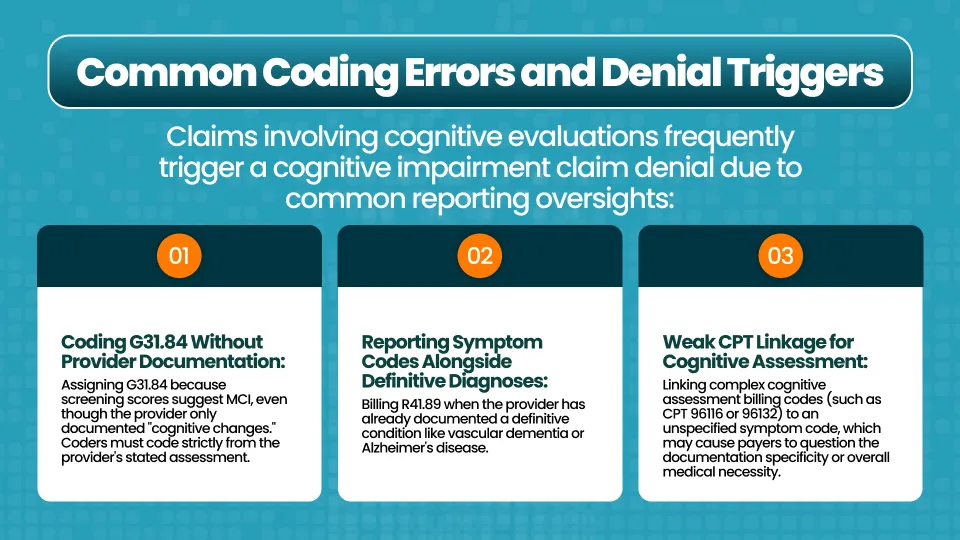
Claims involving cognitive evaluations frequently trigger a cognitive impairment claim denial due to common reporting oversights:
- Coding G31.84 Without Provider Documentation: Assigning G31.84 because screening scores suggest MCI, even though the provider only documented "cognitive changes." Coders must code strictly from the provider's stated assessment.
- Reporting Symptom Codes Alongside Definitive Diagnoses: Billing R41.89 when the provider has already documented a definitive condition like vascular dementia or Alzheimer's disease.
- Weak CPT Linkage for Cognitive Assessment: Linking complex cognitive assessment billing codes (such as CPT 96116 or 96132) to an unspecified symptom code, which may cause payers to question the documentation specificity or overall medical necessity.
How to Prevent and Fix Denials
When a claim for cognitive evaluation is rejected or flagged during a review, practices should follow a structured remediation strategy:
- Perform an Internal Audit: Periodically review neurology and primary care progress notes to verify that code selections align precisely with physician statements.
- Update EHR Documentation Templates: Modify electronic health record templates to prompt clinicians for clear, unambiguous diagnostic statements regarding cognitive conditions.
- Correct and Resubmit First: If a provider clearly documented mild cognitive impairment in the note but R41.89 was mistakenly billed, update the claim to G31.84 and resubmit it promptly.
- Prepare Clinical Appeals: If a payer denies R41.89 during an initial evaluation phase, submit the clinical record along with standardized testing results to demonstrate clear medical necessity for the workup.
Frequently Asked Questions
1. What is the ICD-10 code for cognitive impairment?
There is no single ICD-10 code for cognitive impairment. The correct selection depends on clinical findings: R41.89 is used for general cognitive symptoms, while G31.84 is reported when the physician explicitly diagnoses mild cognitive impairment of uncertain etiology.
2. What is the difference between R41.89 and G31.84?
R41.89 is a general symptom code assigned for non-specific cognitive signs and complaints. G31.84 is a specific neurological diagnosis code reserved for cases where the provider explicitly diagnoses mild cognitive impairment.
3. Can coders assign G31.84 without a provider diagnosis?
No. Coders cannot infer a diagnosis of G31.84 based on test scores alone. Official coding guidelines state that the provider must explicitly state "mild cognitive impairment" in the medical record.
4. Why do cognitive impairment claims get denied?
Claims are commonly denied due to poor linkage between CPT testing codes and symptom diagnoses, lack of documented medical necessity, or using an unspecified symptom code when a definitive diagnosis was noted in the chart.
5. Is there a different code for dementia?
Yes. Dementia represents a major neurocognitive disorder and is coded in the F01 to F03 code range based on the underlying cause, severity and presence of behavioral disturbances.
Conclusion
Navigating the choice between the R41.89 ICD-10 code and the G31.84 ICD-10 code requires strict adherence to official coding guidelines and documented clinical findings. Using R41.89 for initial symptom presentations and transitioning to G31.84 only when documented by the provider ensures accurate billing and protects your practice against audit risks.
Unsure whether your neurology or geriatric claims are coded correctly? Request a coding review from Medical Lien Management. You can also explore our specialized service offerings in Denial Management and Medical Coding to optimize your revenue cycle operations.