

Joint pain is among the top reasons people book a visit. Behind the scenes, someone has to turn that complaint into a diagnosis code that payers accept. For many encounters, that code is M25.50.
This guide explains what M25.50 ICD-10 means, when it fits and how to bill it without trouble.
What Is M25.50?
M25.50 is the code for pain in an unspecified joint. If you have searched for pain in unspecified joint ICD-10 details, here is the short version: the code reports pain in joint with no joint or side identified. It belongs to the family of musculoskeletal pain codes in the M25 range and it reflects the clinical term arthralgia.
It is a symptom code, so it describes what the patient feels and not the underlying disease.
Is M25.50 a Billable Code?
Yes. Coders often ask whether the M25.50 billable code status holds up, and it does. It is a complete, billable ICD-10 code that can appear on a claim. Billable does not mean always accepted, though. Payers may still ask for more detail, especially when a procedure or imaging study is billed.
Regarding the ICD-10-CM 2026 update, as far as I know M25.50 continues to work the same way. Even so, check the current code set before you finalize any claim, since annual updates can change codes and instructions.
When to Use M25.50
Knowing when to use M25.50 saves a lot of trouble. It fits in these situations:
- The patient reports joint pain but cannot say which joint is involved
- The provider documents generalized aching across several joints without a defined source
- An early visit focuses on gathering history before a clearer diagnosis emerges
It does not fit when the note names a joint. If the provider writes “left knee pain,” a left knee code is the correct choice. Using M25.50 in that case wastes useful detail.
Joint Pain Diagnosis Codes Beyond M25.50
The wider set of joint pain diagnosis codes includes joint-specific options with right and left versions. These give payers more information and often lead to fewer denials. When the provider confirms a condition, such as osteoarthritis or gout, that diagnosis should replace the symptom code.
A reliable diagnosis code lookup helps you compare options. Search by the joint named in the note, then review the code descriptions and any notes before you choose.
M25.50 and Medical Necessity
M25.50 medical necessity is where claims often succeed or fail. A symptom code alone can justify an office visit and a basic evaluation. It may not justify more costly care, such as advanced imaging, injections, or a long course of therapy.
To support necessity, the chart should show:
- How long the pain has lasted
- How severe it is and how it affects daily activities
- What treatments the patient already tried
- Exam findings and the clinical reasoning behind each order
Payers want to see a clear link between the complaint and the service. A vague note makes that link hard to draw.
Understanding Joint Pain Causes
Joint pain causes a wide range. Common ones include overuse, injury, osteoarthritis, inflammatory arthritis, infection and referred pain from nearby structures. Because the possibilities are broad, providers often start with symptom coding and narrow things down over time.
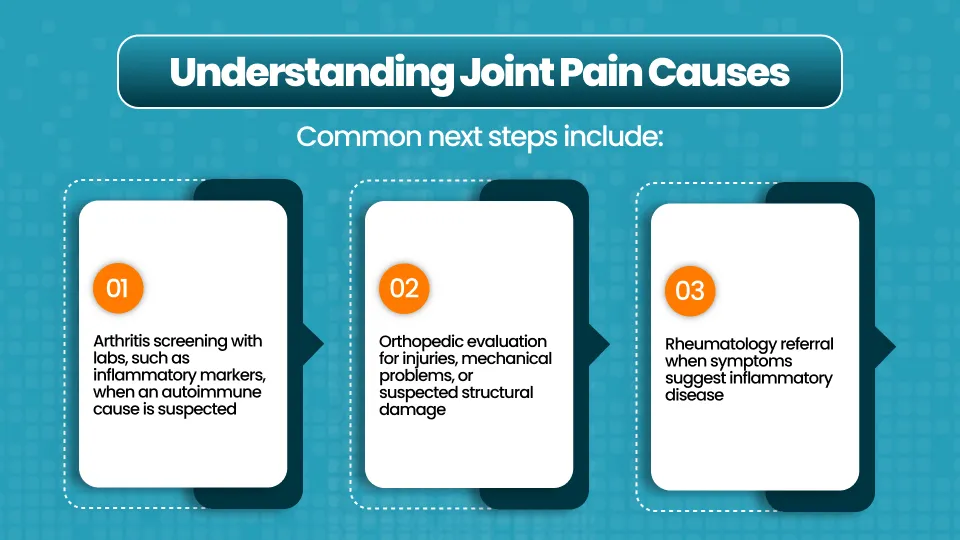
Common next steps include:
- Arthritis screening with labs, such as inflammatory markers, when an autoimmune cause is suspected
- Orthopedic evaluation for injuries, mechanical problems, or suspected structural damage
- Rheumatology referral when symptoms suggest inflammatory disease
When these steps happen, the diagnosis code should evolve with them. A referral note that still says “joint pain, unspecified” after imaging confirms a diagnosis is a common source of avoidable denials.
Joint Pain ICD-10 Billing Tips
Strong joint pain ICD-10 billing comes down to a few habits:
- Capture the joint and side early. A single question at intake often settles it.
- Update the code as the picture clears. Move from symptom to diagnosis when the provider confirms one.
- Link each CPT code to a diagnosis that supports it. Mismatches draw denials.
- Avoid repeating M25.50 across many visits. Persistent use can look like incomplete documentation.
- Review denials by code. If M25.50 shows up often, find out why.
Many practices build a short checklist into their EHR so providers see a prompt for joint and side each time they select a pain diagnosis.
Frequently Asked Questions
What does M25.50 mean?
M25.50 is the ICD-10-CM code for pain in an unspecified joint.Is M25.50 billable?
Yes, it is a valid and billable code, though payers may prefer a more specific one.When should I avoid M25.50?
Avoid it when the note names a specific joint or states a confirmed diagnosis, such as osteoarthritis.Does M25.50 support medical necessity for imaging?
Not always. Payers often want a more specific code and documentation of symptoms, exam findings and treatment tried.Is M25.50 the same as arthralgia?
The terms are closely related. Arthralgia means joint pain and M25.50 reports it when the joint is not specified.Conclusion
M25.50 is a useful code when the facts truly are unspecified and a weak one when the chart already has more to say. Matching the code to the documentation and updating it as the clinical picture sharpens, keeps claims clean and payers satisfied.
If your practice sees frequent denials tied to joint pain, a quick review of your coding and documentation habits is a smart place to start. Reach out to a coding specialist if you want a second set of eyes.