

Ask three coders to pick the right ICD-10 code for fatigue and you may get three different answers. That is because fatigue and its close cousins sit side by side in the same code family, and the differences are easy to miss.
This guide breaks down the three codes people mix up most, shows where each belongs and gives you a simple way to choose.
Where Fatigue Lives in ICD-10
All three codes belong to the malaise and fatigue (R53 category). This group is part of the symptom chapter, which is a reminder that these are signs, not diagnoses. Symptom coding is appropriate when the provider has not yet identified a cause.
R53.83: Other Fatigue
R53.83 is the everyday fatigue code. People searching for other fatigue ICD-10 information are usually looking for this one. It captures tiredness, lack of energy and lethargy that do not fit a more specific code.
Use it when the provider documents fatigue without a defined duration or a known cause. Words like tiredness and lethargy in the note usually point here.
R53.82: Chronic Fatigue, Unspecified
The R53.83 vs R53.82 question comes down to time and pattern. R53.82 is for chronic fatigue, unspecified. The provider should document that the fatigue is persistent or long lasting. A note that says “fatigue for six months” supports R53.82 far better than “feeling tired today.”
People often search for a chronic fatigue ICD-10 code and land here, but there is a catch. This code is not the same as a diagnosis of chronic fatigue syndrome. When a provider diagnoses chronic fatigue syndrome or G93.32 myalgic encephalomyelitis, the G93.32 code is the better fit.
R53.1: Weakness
The R53.1 weakness ICD-10 code stands apart from the fatigue codes. It describes weakness, including asthenia documented without more detail. This is where weakness vs. fatigue matters.
- Fatigue is a feeling of tiredness or low energy.
- Weakness is a loss of physical strength, such as difficulty lifting an arm or standing up.
A patient who says “I have no energy” generally points to fatigue. A patient who says “my legs feel weak and give out” points to weakness. When the note is unclear a quick query to the provider is better than a guess.
Quick Comparison
Code | Description | Best Used When |
R53.83 | Other fatigue | Tiredness or lethargy without a stated duration |
R53.82 | Chronic fatigue, unspecified | Fatigue is documented as persistent or long term |
R53.1 | Weakness | Loss of strength or asthenia is documented |
G93.32 | Myalgic encephalomyelitis/chronic fatigue syndrome | The provider diagnoses the syndrome |
Reading Excludes Notes
Coders sometimes skip the instructional notes and that is where errors creep in. Excludes1 and excludes2 notes tell you which codes cannot or can be reported together.
An Excludes1 note means two conditions should not be coded together. An Excludes2 note means the conditions can occur together, so both may be reported when documented. Under the R53 category, notes steer you away from certain conditions, such as age-related weakness and chronic fatigue syndrome, which have their own codes. Always read the notes in the current code set before you finalize a claim.
Fatigue Coding Guidelines to Follow
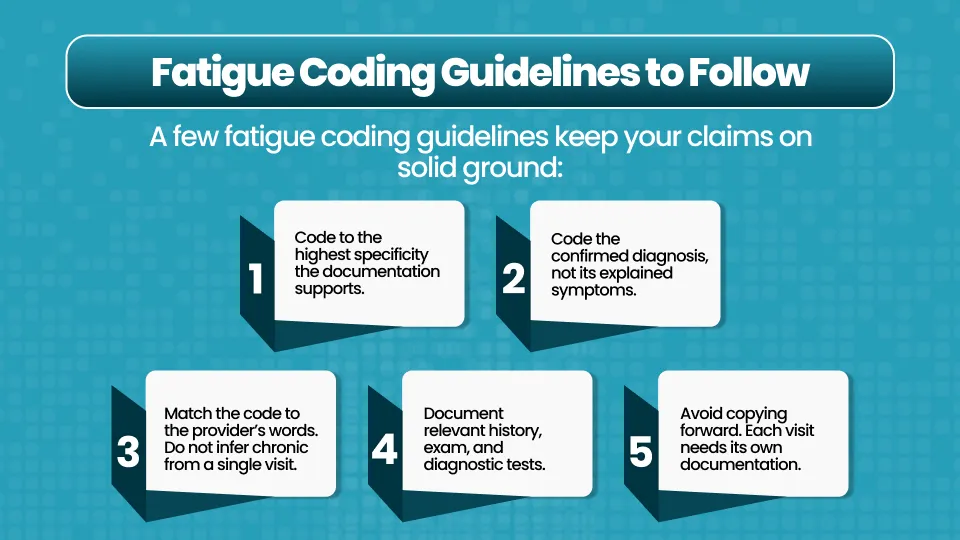
A few fatigue coding guidelines keep your claims on solid ground:
- Code to the highest specificity the documentation supports.
- Do not code a symptom when a related diagnosis is confirmed. If anemia explains the fatigue, anemia leads.
- Match the code to the provider’s words. Do not infer chronic from a single visit.
- Support the workup. Notes should explain the history, exam, and any tests ordered as part of the differential diagnosis.
- Avoid copying forward. Each visit needs its own documentation.
Use the Right Tools
A reliable ICD-10 code lookup tool saves time and reduces mistakes. Search by term, then read the full code description and the notes around it before choosing. Tools that update with each code set release help prevent the use of retired codes.
Tools only go so far, though. Coders still need judgment, which is why medical coding training matters. Refresher sessions on symptom codes, instructional notes and documentation standards pay off in fewer denials and fewer queries.
A Simple Decision Path
When a chart mentions fatigue, ask these questions in order:
- Is a cause or syndrome diagnosed? If yes, code that diagnosis.
- Is the problem weakness, not tiredness? If yes, consider R53.1.
- Is the fatigue described as chronic or persistent? If yes, consider R53.82.
- Otherwise, R53.83 is likely the right choice.
This path will not replace clinical judgment, but it keeps your team consistent.
Frequently Asked Questions
What is the ICD-10 code for fatigue?
The most common code is R53.83, other fatigue. Chronic fatigue, unspecified, is R53.82.What is the difference between R53.83 and R53.82?
R53.83 covers general fatigue, while R53.82 is for fatigue documented as chronic and unspecified.Is weakness the same as fatigue in ICD-10?
No. Weakness is coded to R53.1, while fatigue is coded to R53.83 or R53.82.Which code do I use for chronic fatigue syndrome?
Use G93.32 when the provider documents myalgic encephalomyelitis or chronic fatigue syndrome.Can R53.83 be the primary diagnosis?
Yes, when fatigue is the reason for the visit and no cause has been identified, though payers expect a reasonable workup.Conclusion
Choosing between R53.83, R53.82, and R53.1 comes down to reading the note closely, noticing duration, and separating tiredness from weakness. A little care at the coding step prevents a lot of cleanup later.
If your team could use a sharper process, consider a short refresher on symptom coding or a review of recent fatigue claims. Small improvements here add up quickly.