
Hand pain is one of the most frequent chief complaints seen in outpatient clinics, urgent care centers, and orthopedic practices. However, billing for non-specific hand pain often leads to unexpected claim denials and delayed reimbursement. Using the primary keyword right hand pain ICD-10 code M79.641 correctly requires a solid understanding of official coding guidelines. While M79.641 is a valid code, payers frequently reject it when clinical notes support a more definitive condition. This guide walks you through proper usage, related codes, documentation requirements, and strategies to prevent claim denials.
M79.641 is the specific ICD-10-CM code used to report pain in the right hand. It applies when a patient presents with pain localized to the right hand, provided no underlying definitive diagnosis; such as osteoarthritis or carpal tunnel syndrome, has been established by the provider.
What Is ICD-10 Code M79.641?
ICD-10-CM code M79.641 is classified under the code category for "Pain in limb, hand, foot, fingers and toes." Specifically, it represents pain in the right hand.
It is important to understand the broader M79.64 code family, which breaks down pain in the hands and fingers by laterality (right versus left) and exact anatomical site. M79.641 is a symptom code vs. definitive diagnosis code. Under ICD-10-CM Official Guidelines for Coding and Reporting, symptom codes should only be reported as the primary diagnosis when a firm underlying condition has not been established by the provider during the encounter.
Related Hand and Finger Codes
To ensure accurate CPT and ICD-10 linkage, medical coders must distinguish between pain in the palm/back of the hand and pain restricted strictly to individual digits.
ICD-10 Code | Description | Clinical Context |
M79.641 | Pain in right hand | Pain localized to the right hand structure |
M79.642 | Pain in left hand | Pain localized to the left hand structure |
M79.643 | Pain in unspecified hand | Avoid when possible; causes M79.641 claim denial or delays |
M79.644 | Pain in right finger(s) | Pain confined specifically to digits of the right hand |
M79.645 | Pain in left finger(s) | Pain confined specifically to digits of the left hand |
M79.646 | Pain in unspecified finger(s) | Unspecified diagnosis; high risk of payer rejections |
When a More Specific Code Is Better
If a physician completes an evaluation and determines the underlying cause of the pain, official coding rules state that the definitive diagnosis must replace or precede the general symptom code. Relying on M79.641 when a specific condition is documented in the assessment and plan is a primary cause of billing rejections.
Common definitive diagnoses that should supersede M79.641 billing include:
- Carpal Tunnel Syndrome (G56.00 – G56.03): Mononeuropathy caused by median nerve compression at the wrist.
- Osteoarthritis of Hand (M19.041 – M19.049): Primary osteoarthritis affecting the joints of the hand.
- Tendinitis and Tenosynovitis (M65.841 – M65.849): Soft tissue inflammation affecting the hand and wrist.
- Injury Codes (S60–S69 series): Traumatic injuries such as sprains, strains, fractures, or contusions of the hand.
Documentation That Supports M79.641
When M79.641 applies; such as during initial evaluation visits before diagnostic test results are returned, the clinical note must clearly substantiate medical necessity. Payers look for comprehensive provider notes containing:
- Laterality: Clear specification of the right hand rather than general bilateral or unspecified notes.
- Onset and Duration: Acute versus chronic presentation details.
- Exact Location and Severity: Specific anatomical areas (e.g., palmar surface, dorsal aspect) and pain scale ratings.
- Physical Exam Findings: Tenderness, swelling, range of motion limitations, or absence of neurological deficits.
- Workup and Plan: Ordered imaging (X-rays, MRI), lab work, or physical therapy referrals to demonstrate ongoing diagnostic investigation.
Common Coding Errors and Denial Reasons
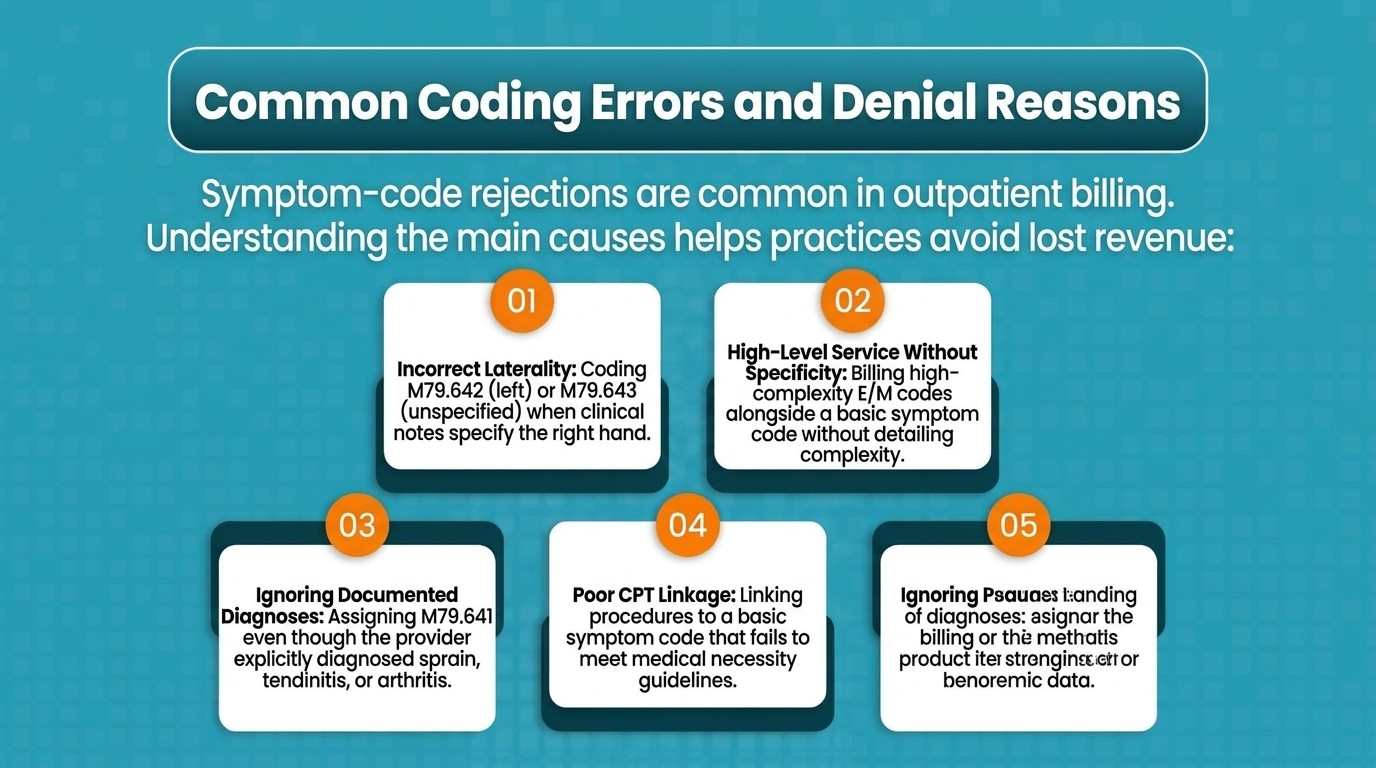
Symptom-code rejections are common in outpatient billing. Understanding the main causes helps practices avoid lost revenue:
- Incorrect Laterality: Coding M79.642 (left) or M79.643 (unspecified) when clinical notes specify the right hand (M79.641 vs M79.642 mix-ups).
- High-Level Service Without Specificity: Billing high-complexity Evaluation and Management (E/M) codes alongside a basic symptom code without detailing diagnostic complexity.
- Ignoring Documented Diagnoses: Assigning M79.641 even though the clinical provider explicitly diagnosed sprain, tendinitis, or arthritis in the note.
- Poor CPT Linkage: Linking procedures (such as joint injections or advanced imaging) to a basic symptom code that fails to meet medical necessity guidelines.
Workers' Comp and Personal Injury Considerations
Handling hand pain claims in personal injury (PI) cases or workers' compensation demands extra precision. Insurers in these sectors scrutinize causation documentation before approving payment or resolving liens.
When dealing with injury-related hand pain, the medical record must explicitly connect the symptoms to a workplace accident, motor vehicle collision, or repetitive trauma. Providers working on a lien basis must document job duties or mechanism of injury thoroughly. In many cases, initial claims use symptom codes like M79.641, but supplementary reports must quickly update the record with definitive injury codes once diagnostic imaging or electrodiagnostic testing is completed.
How to Respond to a Denial
If a claim containing M79.641 is denied for lack of medical necessity or non-specific coding, follow this straightforward workflow:
- Review Remittance Advice: Identify the precise denial code (e.g., CO-16 or CO-50).
- Examine the Provider Note: Check if the physician documented a specific condition (like strain, tendinitis, or nerve entrapment) that was omitted on the original claim.
- Correct and Resubmit: If a definitive diagnosis is present in the note, update the primary ICD-10 code and resubmit as a corrected claim.
- Submit Clinical Appeal: If M79.641 remains the only appropriate code, submit the progress note with highlighted examination findings to demonstrate ongoing workup and medical necessity.
Frequently Asked Questions
1. What is the ICD-10 code for right hand pain?
The primary pain in the right hand ICD-10 code is M79.641. It covers non-specific pain localized to the right hand when no underlying definitive diagnosis is established.
2. What is the difference between M79.641 and M79.644?
M79.641 applies to general pain located in the right hand (including the palm or dorsum), whereas M79.644 is designated specifically for pain restricted to the fingers of the right hand.
3. Is M79.641 a specific enough diagnosis for payers?
Yes, M79.641 is a fully specified ICD-10-CM code that includes laterality. However, some commercial payers may request a more specific structural or neurological diagnosis if symptoms persist.
4. Why is M79.641 sometimes denied?
Denials usually occur because the payer requires a definitive diagnosis, the code is linked to a procedure that demands higher medical necessity, or the clinical note contains a confirmed diagnosis that was not billed.
5. Can I use M79.641 with a definitive hand diagnosis?
Generally, no. Official coding guidelines state that if a definitive condition (such as osteoarthritis or carpal tunnel syndrome) explains the hand pain, you should code the definitive condition instead of the symptom code.
Conclusion
Accurate coding for right hand pain ICD-10 code M79.641 requires balancing lateral specificity with diagnostic completeness. While M79.641 serves as an accurate code during initial patient visits, transitioning to a definitive diagnosis whenever supported by clinical documentation protects your practice against unnecessary denials.
Seeing symptom-code denials? Medical Lien Management's certified coders can audit your claims and help recover revenue. Exploring related billing guides or specialized Medical Billing & Coding, Workers' Compensation Billing and Personal Injury Lien workflows can further streamline your practice operations.