
Depression is among the most frequently coded conditions in behavioral health, primary care, and outpatient psychiatry. However, achieving accurate MDD billing and coding remains a persistent challenge for practice managers and billing teams. Choosing the correct ICD-10 code for major depressive disorder requires distinguishing between a single isolated episode and a pattern of recurrence.
Unspecified coding choices and incomplete medical documentation frequently trigger depression claim denials, delayed payments, or audits. Understanding the clinical distinctions between the F32 and F33 code families ensures compliant reporting, reflects true patient complexity, and protects practice revenue in 2026.
F32 is the ICD-10-CM category for a single episode of major depressive disorder; F33 is for recurrent major depressive disorder. Choosing between them depends on the clinician's documented patient history regarding past depressive episodes, along with specific severity and remission status modifiers.
What Is the ICD-10 Code for Major Depressive Disorder?
In the ICD-10-CM classification system, Major Depressive Disorder (MDD) is categorized under major diagnostic categories in Chapter 5 (Mental, Behavioral, and Neurodevelopmental disorders). The code structure aligns closely with diagnostic criteria outlined in the DSM-5-TR.
Rather than utilizing a single universal depression ICD-10 code, ICD-10-CM divides MDD into two primary code families:
- F32 Series: Represents a single, discrete major depressive episode.
- F33 Series: Represents F33 recurrent depression code selections, applied when a patient has experienced two or more major depressive episodes in their lifetime, separated by an interval of at least two consecutive months without significant depressive symptoms.
Coders must remember that code selection depends strictly on clinician documentation. Coders cannot infer episode history, severity, or remission status without explicit provider statements in the medical record.
F32 vs. F33: Key Differences
Understanding the structural differences between major depressive disorder ICD-10 codes helps billing staff spot documentation gaps before claims are submitted to commercial or government payers.
Feature | F32 Code Family | F33 Code Family |
Clinical Description | Single episode of major depressive disorder | Recurrent major depressive disorder |
Episode History | Patient is experiencing their first documented major depressive episode | Patient has a documented history of two or more distinct depressive episodes |
Common Subcodes | F32.0 (Mild), F32.1 (Moderate), F32.2 (Severe w/o psychosis), F32.3 (Severe w/ psychosis) | F33.0 (Mild), F33.1 (Moderate), F33.2 (Severe w/o psychosis), F33.3 (Severe w/ psychosis) |
Unspecified Codes | F32.9 (Major depressive disorder, single episode, unspecified) | F33.9 (Major depressive disorder, recurrent, unspecified) |
Documentation Needed | Current episode severity, presence of psychotic features, functional impact | History of previous episodes, current episode severity, remission status |
How Severity and Remission Are Coded
Both the F32 and F33 code categories rely on additional characters to denote current severity, psychotic features or remission status. Submitting a complete code requires capturing these specific clinical attributes:
1. Severity Specifiers
- Mild (F32.0 / F33.0): Few symptoms beyond those required for diagnosis, producing mild impairment in social or occupational functioning.
- Moderate (F32.1 / F33.1): Symptom count and functional impairment fall between mild and severe presentation.
- Severe Without Psychotic Features (F32.2 / F33.2): High symptom intensity, causing severe functional disruption without hallucinations or delusions.
- Severe With Psychotic Features (F32.3 / F33.3): Severe depressive presentation accompanied by mood-congruent or mood-incongruent hallucinations or delusions.
2. Remission Specifiers (Primarily F33 Category)
- In Partial Remission (F33.41): Symptoms of a previous major depressive episode are present, but full criteria are not met, or a period without significant symptoms lasts less than two months.
- In Full Remission (F33.42): During the past two months, no significant signs or symptoms of the disturbance were present.
Why Specificity Matters
Relying on an unspecified diagnosis code such as F32.9 or F33.9 is a primary driver of payer scrutiny in behavioral health billing. While unspecified codes remain valid within the tabular list, commercial health plans and Medicare Advantage programs routinely flag them during routine reviews.
Comparing F32.9 vs F33.9 shows that both fail to capture the clinical nuance required for modern reimbursement frameworks:
- Medical Necessity Claims: Payers evaluate whether high-complexity evaluation and management (E/M) services or prolonged psychotherapy sessions are justified when linked to an unspecified diagnosis.
- Risk Adjustment: In risk-adjusted Medicare Advantage and ACO models, granular diagnoses that record severity (such as severe MDD vs. mild MDD) accurately reflect patient disease burden, directly influencing hierarchical condition category (HCC) capture.
Documentation That Supports the Right Code
To withstand a payer audit and demonstrate medical necessity, the provider's progress note must contain concrete clinical details rather than brief summary statements.
Key documentation elements include:
- Episode Pattern: Clear notation of whether this presentation is a first-time event or part of a documented history of recurring depression.
- Severity Assessment: Documentation of symptom count, functional impairment, or validated screening tool findings (such as documented PHQ-9 scores).
- Psychotic Symptoms: Explicit statement noting the presence or absence of hallucinations or delusions.
- Functional Impact: Notes describing how symptoms affect work, personal relationships, or daily independent living.
- Treatment Plan: Outline of planned pharmacotherapy, psychotherapy, safety planning, or referrals.
Common Coding Errors and Denial Reasons
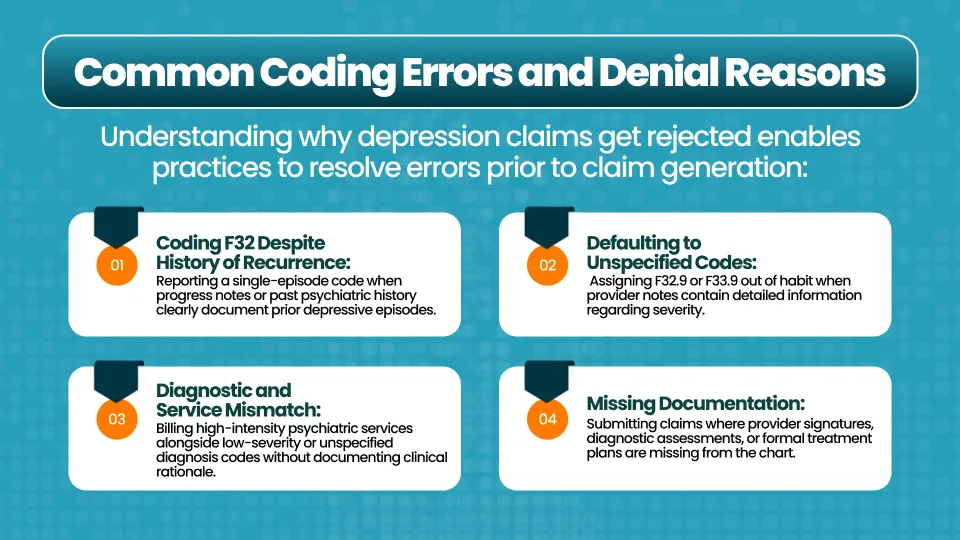
Understanding why depression claims get rejected enables practices to resolve errors prior to claim generation:
- Coding F32 Despite History of Recurrence: Reporting a single-episode code when progress notes or past psychiatric history clearly document prior depressive episodes.
- Defaulting to Unspecified Codes: Assigning F32.9 or F33.9 out of habit when provider notes contain detailed information regarding severity.
- Diagnostic and Service Mismatch: Billing high-intensity psychiatric services alongside low-severity or unspecified diagnosis codes without documenting clinical rationale.
- Missing Documentation: Submitting claims where provider signatures, diagnostic assessments, or formal treatment plans are missing from the chart.
How to Prevent and Fix Behavioral Health Denials
When claims encounter rejections, practices should adopt a proactive workflow to recover revenue and prevent future billing disruptions:
- Conduct Internal Coding Audits: Periodically audit behavioral health records to ensure code selections match clinician documentation.
- Standardize Clinical Templates: Update electronic health record (EHR) documentation templates to prompt clinicians for severity, episode history, and remission status during initial evaluations.
- Resubmit vs. Appeal Strategy: If a claim was denied due to an incorrect code that is clearly corrected in the medical record, correct the code and resubmit. If the coding was accurate but rejected for medical necessity, submit a formal appeal accompanied by progress notes, treatment plans, and standardized screening scores.
Frequently Asked Questions
1. What is the ICD-10 code for major depressive disorder?
There is no single code. Major depressive disorder is coded using the F32 category for a single episode or the F33 category for recurrent episodes, with additional digits indicating severity and remission status.
2. What is the difference between F32 and F33?
F32 is assigned for a single, isolated major depressive episode. F33 is used when a patient has a documented history of two or more major depressive episodes.
3. When should F33 be used instead of F32?
F33 should be reported when the clinician explicitly documents that the patient has experienced prior major depressive episodes separated by at least two symptom-free months.
4. Why do unspecified depression codes cause denials?
Payers often view unspecified codes (like F32.9 or F33.9) as lacking detail to justify the medical necessity of ongoing psychotherapy, complex E/M services, or specialized behavioral healthcare.
5. What documentation supports a major depressive disorder diagnosis code?
Documentation should include episode history, duration of symptoms, severity markers (such as PHQ-9 scores), functional impairment details, presence or absence of psychotic features, and a clear treatment plan.
Conclusion
Mastering the selection between F32 and F33 code families is essential for maintaining compliant behavioral health billing practices. By capturing laterality, episode history, severity, and remission status, practices can ensure accurate claims submission, support medical necessity, and reduce audit exposure.
Want fewer behavioral health denials? Medical Lien Management can review your coding and strengthen your overall revenue cycle. You can also explore our specialized services in Medical Billing & Coding, Denial Management, and Revenue Cycle Management to keep your practice financially healthy.