
A patient reports aching in the shoulder. The provider notes “joint pain.” The coder grabs the quickest option and moves on. That quick option is often M25.50, and it is one of the most common reasons musculoskeletal claims stall.
Understanding M25.50 vs specific joint pain code selection is a small skill with a big payoff. It affects denials, medical necessity reviews and how smoothly your claims move through payer edits.
What M25.50 Means
M25.50 is the code for pain in an unspecified joint. If you search for unspecified joint pain ICD-10 guidance, you will find that the code is valid and billable, but it tells the payer very little. It does not say which joint hurts or which side of the body is affected.
Under the ICD-10-CM guidelines, unspecified codes are meant for situations where the documentation truly lacks detail. They are not meant to be a default.
Why Specificity Matters
Coding specificity helps players understand what you treated and why. A claim for a knee injection or a course of therapy that points to “unspecified joint” invites questions. A claim that points to right knee pain tells a clear story.
Good coding specificity for medical billing supports:
- Faster adjudication with fewer edits
- Stronger medical necessity arguments
- Cleaner data for quality reporting
- Fewer record requests from payers
Joint Pain ICD-10 Codes by Joint
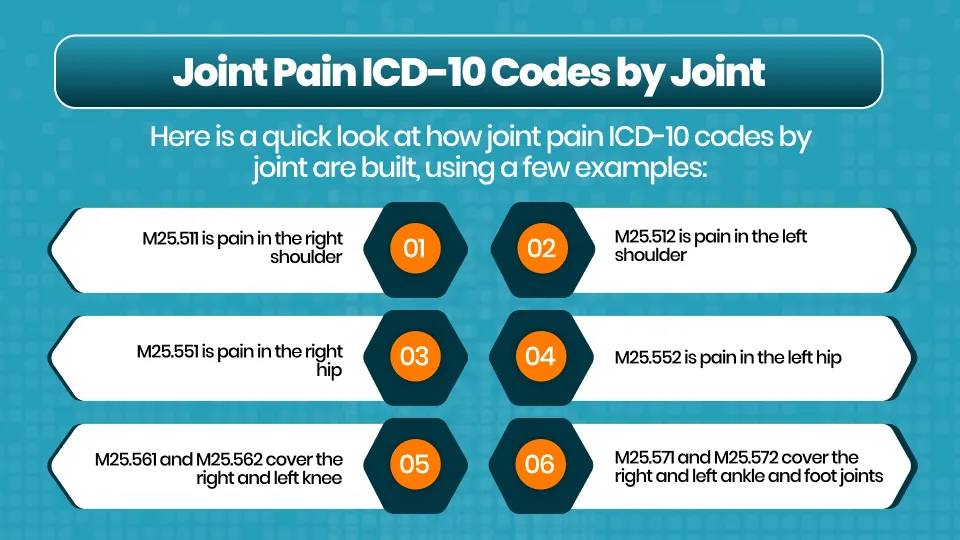
The M25.5 category breaks pain into joint-specific codes (knee, shoulder, hip, ankle) and more. Here is a quick look at how joint pain ICD-10 codes by joint are built, using a few examples:
- M25.511 is pain in the right shoulder
- M25.512 is pain in the left shoulder
- M25.551 is pain in the right hip
- M25.552 is pain in the left hip
- M25.561 and M25.562 cover the right and left knee
- M25.571 and M25.572 cover the right and left ankle and foot joints
Notice the final digit. It signals laterality (left, right, bilateral). Most codes in this category have separate right and left versions and no bilateral version, so when both sides are treated, you generally report each side separately. Always confirm in your current code set.
M25.50 Denial Reasons
Teams often ask about M25.50 denial reasons. The most common ones are:
- The payer wants a joint-specific code for the service billed, such as an injection or imaging study.
- The diagnosis does not support the procedure, which raises a medical necessity flag.
- The visit notes name a joint, but the claim does not.
- A more definitive diagnosis, such as osteoarthritis, was documented and should have been used.
Remember that M25.50 falls into the family of symptom codes. Once a provider documents a confirmed cause, the symptom code usually should not lead the claim.
Specialty Settings Feel This the Most
Orthopedic coding leans heavily on joint and side. Orthopedic practices see a steady stream of shoulder, knee, and hip complaints, and payers know it. Unspecified codes stand out in that setting.
Physical therapy billing faces the same pressure. Therapists need a treatment diagnosis that matches the plan of care. A therapy claim tied to “joint pain, unspecified” often draws questions about whether the services are skilled and necessary. Pairing a medical diagnosis with a specific treatment diagnosis, such as pain in the left shoulder, paints a clearer picture.
Joint Pain Documentation Tips
Most specificity problems start in the note, not the code set. These joint pain documentation tips help providers give coders what they need:
- Name the joint. Write “right knee,” not “leg pain” or “joint pain.”
- State the side. Left, right, or both should be easy to find.
- Describe the pain. Include onset, duration, severity, and what makes it better or worse.
- Record the evaluation. Exam findings, range of motion, and imaging belong in the encounter documentation.
- Document the plan. Tie each order or referral to the complaint.
- Use the clinical term when accurate. If the provider diagnoses arthralgia, say so clearly.
A short template inside your EHR can prompt for joint and side every time. That one change can cut unspecified codes quickly.
When M25.50 Is Still Appropriate
Unspecified does not mean forbidden. If a patient reports general joint pain at an initial visit, and the provider cannot yet pinpoint a location, M25.50 can be correct. The key is that the note, not convenience, drives the choice. Over a few visits, documentation should usually become more precise.
Getting Help With Specificity
Many practices find that a quick audit of unspecified codes reveals clear patterns by provider or location. If your team lacks time for that work, ICD-10 coding services can review samples, train staff, and set up edits that catch vague codes before they leave your office.
Frequently Asked Questions
What is the difference between M25.50 and a specific joint pain code?
M25.50 does not identify the joint or side. Specific codes, such as M25.511 for right shoulder pain, identify both.Is M25.50 a valid ICD-10 code?
Yes. It is valid and billable, but payers often prefer more detail.How do I code pain in both knees?
Report the right knee code and the left knee code separately, since there is generally no bilateral option in this category.Why was my M25.50 claim denied?
Common reasons include lack of specificity, poor support for the billed service, and a more definitive diagnosis being documented.Can physical therapists use M25.50?
They can, but a specific treatment diagnosis usually supports the plan of care better and reduces payer questions.Conclusion
The gap between M25.50 and a joint-specific code is often just a few words in the chart. Naming the joint and the side takes seconds and it protects your claims from avoidable denials.
If you want to reduce unspecified codes across your practice, start with a small audit and a simple documentation prompt. Reach out to a coding partner if you would like a hand getting it done.