

Providing care coordination for high-need, multi-condition patients is clinically demanding and resource-intensive. While standard Chronic Care Management compensates practices for basic care coordination, complex CCM billing using CPT 99487 provides higher reimbursement to reflect intensive clinical oversight. However, higher reimbursement inevitably brings increased scrutiny from payers during a medical coding audit.
Because complex chronic care management demands explicit clinical decision-making records, strict time logs, and clear supervisory documentation, avoiding a CPT 99487 denial depends entirely on audit-ready chart management. This guide outlines essential billing rules, documentation standards, and compliance strategies needed to protect your practice revenue.
CPT 99487 covers the first 60 minutes of clinical staff time provided per calendar month for complex chronic care management. It requires moderate or high complexity medical decision making along with the establishment or substantial revision of a comprehensive care plan.
What Is CPT 99487?
CPT 99487 is the primary base code for complex Chronic Care Management (CCM) services rendered by clinical staff under the direction of a physician or qualified healthcare professional (QHP).
Unlike standard care management, complex CCM addresses patients whose health status is fragile or unpredictable. When evaluating what CPT 99487 is, billing teams must recognize that it is not simply a higher time threshold for standard care; it requires active clinical intervention and complex decision-making to stabilize the patient's conditions.
Who Qualifies for Complex CCM?
To bill CPT 99487, the patient must meet specific medical eligibility thresholds established by the American Medical Association (AMA) and Centers for Medicare & Medicaid Services (CMS):
- Multiple Chronic Conditions: The patient must have two or more chronic conditions expected to last at least 12 months or until death.
- High Clinical Risk: Conditions must place the patient at significant risk of death, acute exacerbation, or functional decline.
- Complex Decision Making: Care management must require moderate or high complexity medical decision making (MDM) by the billing clinician.
99487 vs 99490 and PCM
Understanding the distinction between 99487 vs 99490 and Principal Care Management (PCM) is essential for correct code selection:
- CPT 99490 (Standard CCM): Requires at least 20 minutes of staff time per month with straightforward or low-complexity MDM.
- CPT 99487 (Complex CCM): Requires the first 60 minutes of clinical staff time per month paired with moderate to high MDM.
- Principal Care Management (PCM): Focuses strictly on a single high-risk condition rather than multiple chronic illnesses.
CPT 99487 Requirements
To report CPT 99487 compliantly, practices must verify that all CPT 99487 requirements are fulfilled during the calendar month:
- Time Minimum: At least 60 full minutes of qualifying clinical staff time directed by a physician or QHP.
- Care Plan Direction: The establishment or substantial revision of a comprehensive care plan.
- Informed Consent: Recorded patient consent (verbal or written) explaining the service, potential cost-sharing, and information sharing rules.
- Supervision Level: Services delivered by clinical staff under general supervision of the billing practitioner.
- Add-On Code Pairing: If care management time reaches 90 minutes, practices can bill add-on code CPT 99489 for each additional 30 minutes.
Complex CCM Documentation Checklist
Building an audit-proof medical record requires complete alignment between clinical care and claims submission. Ensure your chart records contain the following:
- Documented Patient Consent: Proof that the patient or legal surrogate agreed to complex CCM services and acknowledged copay obligations.
- Qualifying Diagnosis Mapping: Explicit listing of two or more chronic conditions placing the patient at high clinical risk.
- Care Plan Record: A copy of the comprehensive care plan showing the exact date it was established or substantially revised.
- MDM Complexity Rationale: Provider progress notes detailing clinical reasoning that supports moderate or high complexity medical decision making.
- Itemized Time Log: Detailed logs displaying dates, start and stop times, specific coordination tasks, and staff credentials.
- Multidisciplinary Coordination Notes: Records of communication with specialists, home health agencies, pharmacies, and community support resources.
- Patient and Caregiver Contacts: Logs of phone calls, secure portal exchanges, or virtual check-ins with the patient or family.
Compliance Risks and Audit Triggers
During a payer audit, improper coding practices can trigger retroactive clawbacks, claim denials or audit flags. Major compliance risks include:
- Billing Complex Care for Routine Cases: Reporting 99487 when patient records indicate stable, low-complexity condition management.
- Copy-Forward Template Cloning: Reusing identical care plans or progress notes month after month without updating clinical details.
- Flawed Time Tracking: Time logs that list rounded numbers, lack exact staff signatures, or fail to hit the required 60-minute threshold.
- Overlapping Care Management: Billing 99487 while another practitioner or facility bills CCM or PCM for the same patient in the same month.
- Missing Informed Consent: Unrecorded consent leading to post-billing patient disputes or audit failures.
Common Claim Errors and Denial Reasons
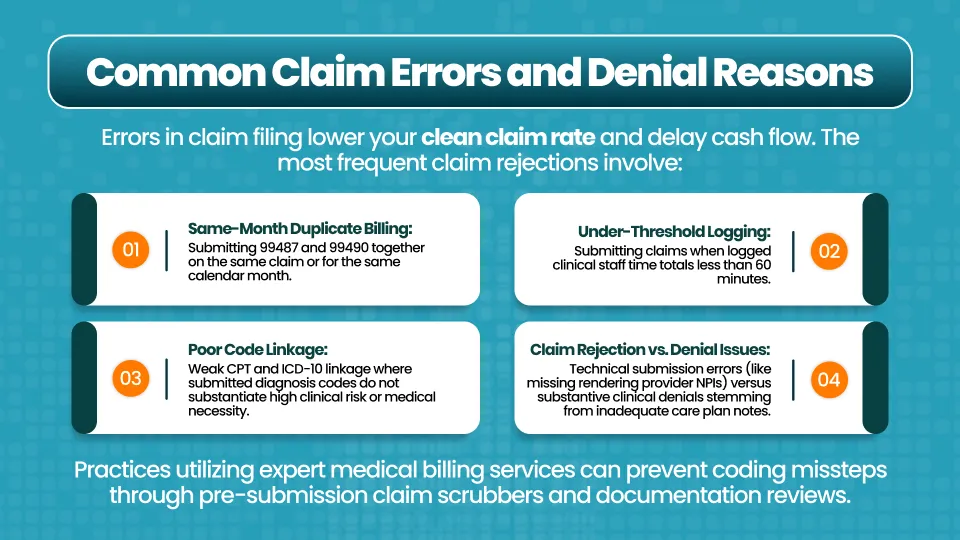
Errors in claim filing lower your clean claim rate and delay cash flow. The most frequent claim rejections involve:
- Same-Month Duplicate Billing: Submitting 99487 and 99490 together on the same claim or for the same calendar month.
- Under-Threshold Logging: Submitting claims when logged clinical staff time totals less than 60 minutes.
- Poor Code Linkage: Weak CPT and ICD-10 linkage where submitted diagnosis codes do not substantiate high clinical risk or medical necessity.
- Claim Rejection vs. Denial Issues: Technical submission errors (like missing rendering provider NPIs) versus substantive clinical denials stemming from inadequate care plan notes.
Practices utilizing expert medical billing services can prevent coding missteps through pre-submission claim scrubbers and documentation reviews.
Building an Audit-Ready Workflow
To maintain CCM audit compliance while scaling your care management program, implement standard operational protocols:
- Standardize EHR Templates: Utilize structured templates that prompt clinical staff to log start/stop times, specific care tasks, and provider supervision notes.
- Integrate Time-Tracking Software: Deploy electronic time tracking that prevents manual time estimation and stops staff from logging duplicate entries across overlapping codes.
- Conduct Internal Coding Audits: Schedule periodic routine chart reviews led by certified coders to verify MDM complexity and care plan updates before filing claims.
- Train Clinical Care Teams: Educate clinical staff on the exact distinction between administrative communication (non-billable) and clinical care management (billable).
- Leverage External Expertise: Partner with specialized billing experts when internal resources are insufficient to manage complex care compliance.
Frequently Asked Questions
What is CPT 99487?
CPT 99487 is the primary CPT code for complex chronic care management, covering the first 60 minutes of clinical staff time in a calendar month for patients with multiple high-risk chronic conditions.
What is the difference between CPT 99487 and 99490?
CPT 99490 covers standard CCM requiring at least 20 minutes of staff time per month with low-to-moderate decision-making. CPT 99487 requires 60 minutes of staff time, moderate or high complexity medical decision making, and intensive care plan updates.
What documentation is required for complex CCM?
A complete chart must include patient consent, a comprehensive care plan showing creation or substantial revision, detailed staff time logs, evidence of multidisciplinary care coordination, and progress notes justifying moderate-to-high MDM.
Can 99487 and 99489 be billed together?
Yes. CPT 99489 is the add-on code used to bill each additional 30 minutes of clinical staff time after the initial 60 minutes of CPT 99487 are completed in the calendar month.
How can practices stay compliant when billing 99487?
Practices maintain compliance by enforcing real-time time tracking, ensuring strong clinician supervision, documenting clear MDM rationale, regularly updating care plans, and conducting routine internal chart audits.
Conclusion
Successfully billing CPT 99487 allows practices to capture rightful compensation for managing severe, multi-condition patients. By strictly satisfying CPT 99487 requirements, maintaining detailed care plans, and enforcing rigorous time logging, your practice can establish a robust, compliant care management program that withstands any payer audit.
Want an audit-ready care management program? Contact Medical Lien Management today to have our specialists review your documentation, workflows, and care management claims.