

Specialists treating patients with a severe, single chronic illness spend considerable time coordinating care between office visits. While many practices are familiar with Chronic Care Management (CCM), Principal Care Management (PCM) allows specialists to bill for managing a single high-risk illness. Understanding CPT 99427 ensures practices capture appropriate reimbursement for extended clinical staff services without running into billing compliance issues.
Because CPT 99427 is a clinical staff add-on code, submitting it correctly requires adherence to strict timing thresholds, care plan documentation, and base-code pairings. This guide covers how to implement CPT 99427 billing efficiently while maintaining audit-proof documentation.
CPT 99427 is an add-on code for each additional 30 minutes of clinical staff time spent providing principal care management during a calendar month, reported directly with the base code CPT 99426.
What Is Principal Care Management?
Principal Care Management focuses on patients with a single high-risk condition that is expected to last at least 3 months or until the end of the patient's life. This complex disease puts the patient at significant risk of hospitalization or functional decline, decompensation, or death.
Unlike general primary care management, PCM is tailored toward disease-specific interventions. It involves establishing or adjusting a continuous care plan, monitoring stabilization, and adjusting treatments for complex illnesses like heart failure, severe COPD, or advanced diabetes.
What Is CPT 99427?
So, what is CPT 99427 in the context of specialty billing? CPT 99427 is the add-on code used to bill clinical staff care management time directed by a physician or qualified healthcare professional (QHP) beyond the initial time requirement.
Key rules for reporting CPT 99427 include:
- Base Code Requirement: Must be billed alongside CPT 99426 (the base code covering the first 30 minutes of clinical staff PCM time).
- Time Increments: Covers each additional 30 minutes of cumulative staff time in a calendar month.
- Billing Limits: Generally reported up to twice per calendar month (covering up to 90 minutes total of clinical staff time when combined with 99426), subject to specific payer rules.
PCM Code Family at a Glance
The PCM code suite is split between physician/QHP personal time and clinical staff time. Understanding the relationship between CPT 99426 and 99427 alongside physician codes prevents coding mistakes.
CPT Code | Provider Role | Service Type | Minimum Time Required |
99424 | Physician / QHP | Base Code | 30 minutes / month |
99425 | Physician / QHP | Add-On Code | Each additional 30 minutes |
99426 | Clinical Staff | Base Code | 30 minutes / month |
99427 | Clinical Staff | Add-On Code | Each additional 30 minutes |
PCM vs CCM: Key Differences
Understanding PCM vs CCM is critical for maintaining compliance. While both address chronic disease management, their eligibility criteria and clinical scopes differ significantly:
- Number of Conditions: CCM requires two or more chronic conditions expected to last at least 12 months. PCM focuses on a single high-risk condition expected to last at least 3 months.
- Care Plan Scope: CCM care plans cover broad, multi-system management. Principal care management requirements focus on a disease-specific plan typically managed by a specialist or dedicated clinician.
- Concurrent Billing: CMS prohibits billing PCM and CCM for the same patient by the same provider within the same calendar month.
Specialists utilizing medical billing services for specialists can streamline code selection based on condition count and care severity.
Documentation Requirements
To satisfy medical necessity standards and avoid a claim denial during a payer audit, proper PCM documentation must contain:
- Patient Consent: Verified patient consent recorded in the medical record prior to initiating PCM services, outlining cost-sharing responsibilities.
- High-Risk Justification: Clear notes demonstrating why the condition carries a significant risk of hospitalization or functional decline.
- Disease-Specific Care Plan: A comprehensive, documented care plan focused on managing, stabilizing, or monitoring the targeted single condition.
- Detailed Time Logs: Accurate tracking of clinical staff time, documenting exact dates, start/stop times, specific activities, and staff credentials.
- Care Coordination Notes: Detailed communication logs with the patient, family caregivers, primary care providers, or other specialists.
Reimbursement Overview
Specific 99427 reimbursement amounts are established annually through the CMS Physician Fee Schedule (PFS). Payment rates vary based on geographic locality adjustments and updated conversion factors.
Because commercial payers may establish distinct payment schedules or place specific limits on add-on units, providers should consult the current CMS fee schedule database or reach out directly to regional payers to verify exact payment rates before submitting claims.
Common Claim Errors Leading to Denials
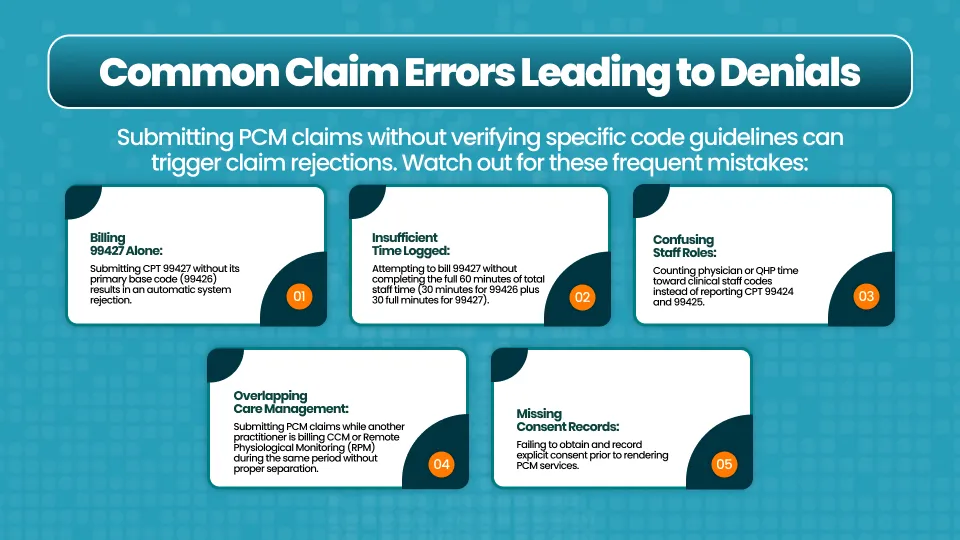
Submitting PCM claims without verifying specific code guidelines can trigger claim rejections. Watch out for these frequent mistakes:
- Billing 99427 Alone: Submitting CPT 99427 without its primary base code (99426) results in an automatic system rejection.
- Insufficient Time Logged: Attempting to bill 99427 without completing the full 60 minutes of total staff time (30 minutes for 99426 plus 30 full minutes for 99427).
- Confusing Staff Roles: Counting physician or QHP time toward clinical staff codes instead of reporting CPT 99424 and 99425.
- Overlapping Care Management: Submitting PCM claims while another practitioner is billing CCM or Remote Physiological Monitoring (RPM) during the same period without proper separation.
- Missing Consent Records: Failing to obtain and record explicit consent prior to rendering PCM services.
Frequently Asked Questions
What is CPT 99427?
CPT 99427 is an add-on code for each additional 30 minutes of clinical staff time spent delivering principal care management during a calendar month, reported under the direction of a physician or QHP.
Can CPT 99427 be billed without 99426?
No. CPT 99427 is strictly an add-on code. It cannot stand alone and must always be reported alongside its base code, CPT 99426 on the same claim.
What is the difference between PCM and CCM?
PCM targets a single high-risk condition expected to last at least 3 months that requires specialized management. CCM requires two or more chronic conditions expected to last at least 12 months or until death.
Is CPT 99427 a remote patient monitoring code?
No. CPT 99427 is a care management code, not a Remote Physiologic Monitoring (RPM) code. While RPM involves continuous digital medical device data collection (such as CPT 99453 or 99454), PCM focuses on overall management, care coordination, and plan adjustments for a single condition.
What documentation supports PCM billing?
Compliance requires documented patient consent, a disease-specific care plan, proof of medical necessity, clinical coordination notes and detailed time tracking logs for all clinical staff time.
Conclusion
Correctly utilizing CPT 99427 allows specialty practices to receive proper reimbursement for the substantial time spent managing complex, single-condition patients. By keeping accurate time logs, adhering to principal care management requirements, and pairing add-on codes correctly with base code 99426, practices can optimize their revenue cycle while avoiding costly claim denials.
Is your specialty practice leaving care management revenue on the table? Contact Medical Lien Management today to learn how our revenue cycle solutions can optimize your care management billing and claim accuracy.